
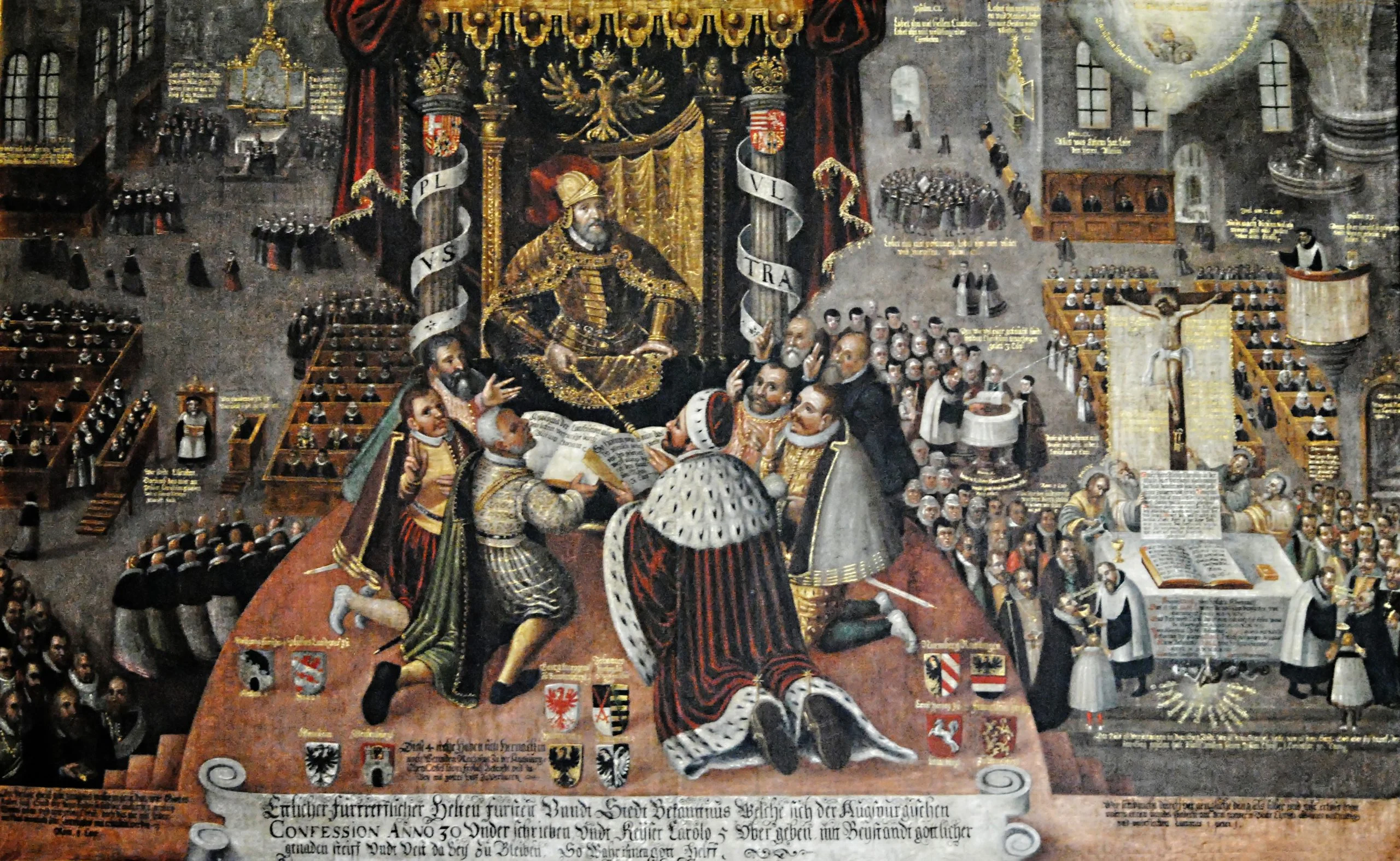
If you have begun attending worship in an Evangelical Lutheran congregation, or have become interested in Lutheran teaching and practice, you should certainly turn to the Augsburg Confession. This foundational confession of the Lutheran Church has profoundly shaped Lutheran identity. To be Lutheran is to be a Christian of the Augsburg Confession.
The document became the foundation for the later confessional writings collected in the Book of Concord in 1580, the symbolic books of the Evangelical Lutheran Church in the German lands. Its final document, the Formula of Concord, identifies the Augsburg Confession as the foremost confessional writing to be acknowledged by an orthodox Lutheran.
These are a few brief notes on this document of the Church.
On 25 June, the worldwide Lutheran community, including Ukraine’s Lutheran churches, commemorates the Augsburg Confession. On that day in 1530, in Augsburg, Bavaria, the confession was presented to Holy Roman Emperor Charles V on behalf of the empire’s Protestant Christians: clergy, princes, nobility and others who supported Martin Luther and his reform of the Western Church.
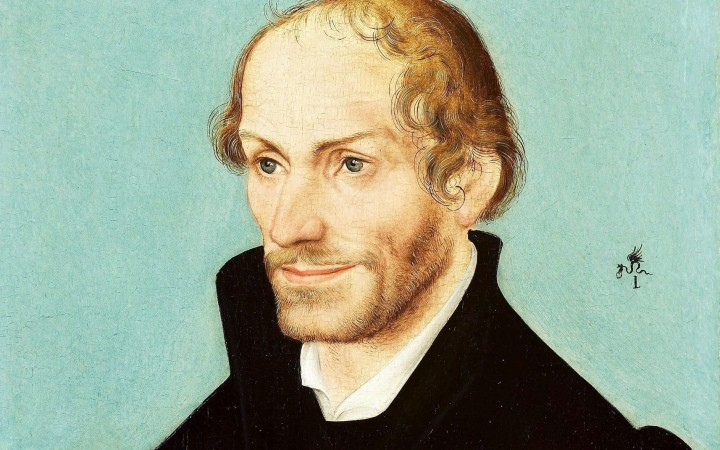
The text was written by Philipp Melanchthon[1], Luther’s “right-hand man”, remembered as a Reformer who “knew how to proclaim the Gospel with love”. Where Luther could be fiery and severe, Melanchthon was his opposite. Luther himself acknowledged, whether approvingly or critically, that he could not have written an evangelical confession as Melanchthon had. In this sense Luther was radical, Melanchthon a traditionalist: “He did not consider himself entitled to teach anything unsupported by the testimony of the ancient Church,” notes Lutheran historian of theology Bengt Hägglund[2]. Charles V received the Latin text, while Saxon Chancellor Christian Beyer read the German version publicly. The versions differ: the German is sometimes fuller and stylistically sharper.
The Confession contains 28 articles. The first 21 proclaim the evangelical and universal Christian faith as understood by the Reformation’s supporters. They affirm the Trinity and Jesus Christ in the spirit of the Nicene-Constantinopolitan Creed, justification by faith, the one holy Church, Christ’s sacraments and other teachings. The remaining seven address what the Reformers considered abuses and errors in the medieval Western Church, including Holy Communion, episcopal authority and monastic vows.
The Augsburg Confession remains the principal confession of Evangelical Lutheran churches worldwide. Our Church’s episcopal constitution states:
“GELCU recognises the Holy Scriptures of the Old and New Testaments as the sole source and firm, infallible norm of church teaching and Christian conduct. It regards the Apostles’, Nicene-Constantinopolitan and Athanasian Creeds of the ancient Church, together with the Lutheran confession, especially the authentic Augsburg Confession and Dr Martin Luther’s Small Catechism, as the clearest and purest expression of the Lord’s Word.”
Preamble, Constitution of the Church Administration (Episcopate) of the German Evangelical Lutheran Church of Ukraine, revised edition, Kyiv, 2021.
The Constitution of the Lutheran World Federation, to which our Church belongs, likewise affirms:
“The Lutheran World Federation confesses the Holy Scriptures of the Old and New Testaments as the only source and norm of doctrine, life and service. It sees in the three ecumenical creeds and the confessions of the Lutheran Church, especially the unaltered Augsburg Confession and Martin Luther’s Small Catechism, a pure exposition of the Word of God.”
Constitution of the Lutheran World Federation, II: Doctrinal Basis.
Much could be said about the Augsburg Confession. Particularly important is its position between reform and tradition: it represents a synthesis of the two. Swiss-American Reformed historian Philip Schaff calls it “the most churchly, the most catholic, the most conservative of Protestant confessions”[3]. In the first volume of Reformacja, Polish Lutheran scholars Łukasz Barański and Jerzy Sojka write: “Today we know a good deal about the diplomatic manoeuvring surrounding the Augsburg Confession. We are familiar with criticism of Melanchthon’s perhaps excessively conciliatory position… Nevertheless, we cannot assess its contents solely through these two factors, treating its continuities with church teaching merely as sacrifices on diplomacy’s altar or as the result of Melanchthon’s excessive desire for unity at any cost. They also express the Reformation’s conviction that it continues the Church, whose earthly existence is guaranteed by Jesus Christ acting in it through his Spirit”[4].
What does this synthesis of reform and tradition involve? I will highlight three aspects, although many more could be named.
Faithfulness to the universal, orthodox faith and the Gospel of salvation
The Augsburg Confession does not begin with an article on Scripture, unlike other sixteenth-century Protestant confessions such as the Belgic and Second Helvetic Confessions. Its first article affirms the Nicene-Constantinopolitan Creed and orthodox Trinitarian teaching. Later articles, particularly Article III, affirm the Chalcedonian confession of Christ’s one person and two natures and faithfulness to the Apostles’ Creed. References to Church Fathers, councils and canon law accompany its scriptural references throughout. On justification, it firmly maintains that salvation comes not through works but through faith alone, with good works as the fruit of genuine faith (Articles IV–VI).
The authority of tradition and the primacy of Scripture
The first part concludes: “Haec fere summa est doctrinae apud nos, in qua cerni potest nihil inesse, quod discrepet a Scripturis, vel ab Ecclesia Catholica, vel ab Ecclesia Romana, quatenus ex scriptoribus nobis nota est.” That is: “This is approximately the sum of our teaching, in which nothing can be found that differs from Scripture, or from the catholic Church, or from the Roman Church as known to us through its writers.” Here lies a distinction between the Reformers and Rome: Scripture takes precedence over all spiritual authorities, but church tradition is not discarded. It remains an authority for teaching and life, as virtually the whole Confession demonstrates. This tradition includes the Fathers, conciliar decisions, canons and customs, including festivals and spiritual practices. The essential requirement is that these serve good order and not be presented as conditions of salvation (Article XV).
Faith in the one holy Church and recognition of canonical order
The Confession describes the Church as the community united by the preaching of the holy Gospel and administration of the holy sacraments. No one should publicly preach God’s Word or administer Christ’s sacraments without a lawful call. It recognises church order and episcopal authority insofar as they serve within divine right and God’s Word (Articles V–XIV and XXVIII). The early Protestants did not believe Christ’s Church had disappeared and needed recreating. According to his promise, it endures until his return. They therefore sought to purify its teaching and life, not found it anew.
The Augsburg Confession has developed from a confessional manifesto presenting Reformation doctrine into an ecumenical document central to Lutheran–Catholic dialogue, including the preparation and signing of the Joint Declaration on the Doctrine of Justification[5] by the Roman Catholic Church and Lutheran World Federation. Our Church published its Ukrainian translation last year.
I encourage our parishioners not to stop with Dr Martin Luther’s Small Catechism, studied before confirmation, but also to read the Augsburg Confession to strengthen their faith and deepen their knowledge of the Church, its theology, structure and tradition.
Vladyslav Fediuk
Master of Religious Studies
Secretary of St Martin of Tours Congregation, Kyiv
Notes
[1] Two books about him have been published in Ukraine: Heinz Scheible, Philipp Melanchthon: Reformer and Humanist, translated from German by Anna Briskina-Müller (Kyiv: Dukh i Litera, 2018), 520 pp.; and Petro Kotliarov, Philipp Melanchthon: Phoenix of the Reformation (Kyiv: Dukh i Litera, 2020), 328 pp. The latter was published with support from Martin-Luther-Bund in Erlangen and our Church through Bishop Pavlo Shvarts.
[2] Bengt Hägglund, History of Theology, translated from Swedish by V. Volodin (St Petersburg: Svetoch, 2001), p. 214.
[3] Philip Schaff, History of the Christian Church, vol. VII: Modern Christianity. The German Reformation, translated from English by O. A. Rybakova, 2nd ed. (St Petersburg: Bibliia dlia vsekh, 2018), p. 426.
[4] Łukasz Barański and Jerzy Sojka, Reformacja. Tom 1. Historia i teologia luterańskiej odnowy Kościoła w Niemczech w XVI wieku, cz. 1 (Bielsko-Biała: Augustana, 2016), p. 176.
[5] Joint Declaration on the Doctrine of Justification, translated from German by Dmytro Tsolin (Kyiv: Dukh i Litera, 2025).