
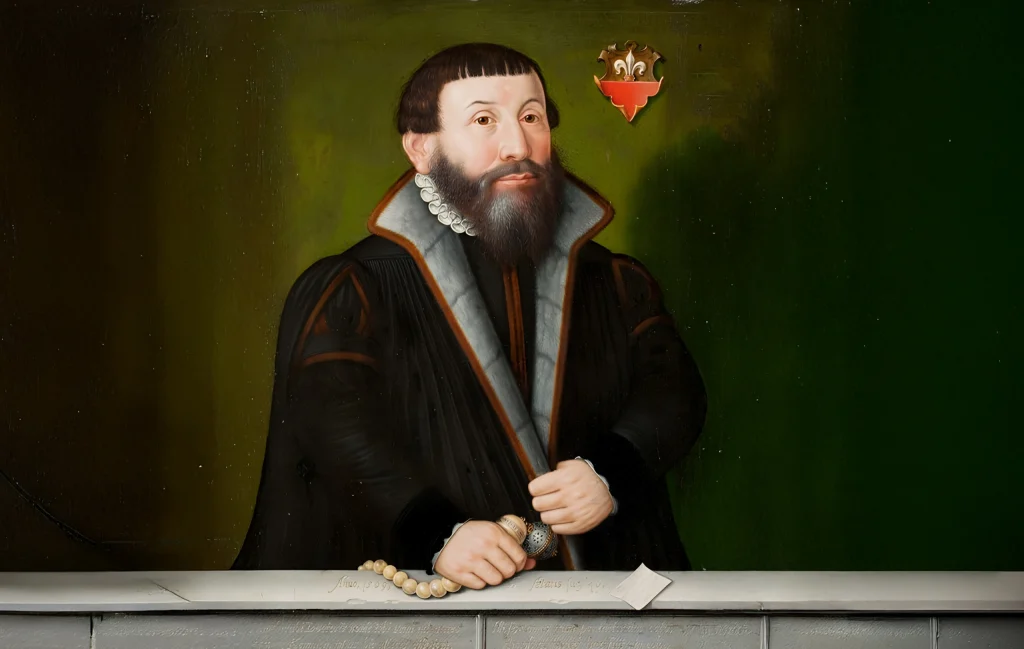
8 April is the commemoration of Martin Chemnitz, one of the most distinguished theologians of the Reformation.
Martin was born on 9 November 1522 in Treuenbrietzen in Brandenburg, into the family of a German cloth merchant.
He was a sickly child, but remarkably persistent in his studies. Without a teacher’s help, he taught himself Latin and also made considerable progress in other subjects.
In 1545, the future theologian entered Wittenberg University, where he studied astronomy and mathematics. There he met Philipp Melanchthon and Martin Luther and listened enthusiastically to their lectures.
In 1548, he graduated from Königsberg University and began studying theology. His appointment as a librarian in Königsberg gave him access to the writings of the Church Fathers and church historians, enabling him gradually to deepen his theological knowledge.
In 1553–54, he completed the studies at Wittenberg University that he had interrupted because of the Schmalkaldic War, was ordained and became pastor of St Giles’ Church. He lectured on theology, particularly Melanchthon’s Loci communes. These lectures later formed the basis of his own Loci theologici, and he wrote many other theological works that remain relevant to Lutheranism worldwide. Their importance includes their defence of the Lutheran teaching on the real presence of the body and blood of Jesus Christ in the Eucharist.
Martin Chemnitz was also a devoted family man. He had six children, to whom he passed on his experience of faith.
Among his chief contributions to the Reformation were his co-authorship of the Formula of Concord, published in 1580, which united Lutherans and brought their internal disputes—particularly over predestination—to an end, and his systematic formulation of Martin Luther’s teaching. For this, he was sometimes called the “second Martin”.
Martin Chemnitz died on 8 April 1586 in Braunschweig, in the Duchy of Brunswick, where he had served as church superintendent since 1567.
His enormous contribution to the Reformation and Lutheran theology is reflected in almost 65 works. Among the most significant are:
Examen Concilii Tridentini
Loci Theologici
De Duabus Naturis in Christo
Enchiridion
Information drawn from:
Concordia Historical Institute: Martin Chemnitz at 500
Encyclopaedia Britannica: Martin Chemnitz
1517: Martin Chemnitz and God’s Election of His Own
Photo: Concordia Historical Institute.